Minimum Order Quantities for Flower Imports from Kenya & Ethiopia
When importing flowers from East Africa, one of the first questions buyers ask is:
“What is the minimum order quantity (MOQ)?”
Understanding MOQs is essential because it directly affects your costs, logistics, and profitability—and in this industry, MOQ is closely linked to air freight economics, not just supplier requirements.
📦 What is a Minimum Order Quantity (MOQ)?
MOQ refers to the smallest volume of flowers you can realistically and efficiently import.
In the flower export industry, this is usually measured in:
- 📦 Boxes (cartons)
- 🌹 Stems per variety
- ✈️ Air freight weight (kg)
👉 And this last point is the most important.
✈️ The Reality: Freight Determines Your MOQ
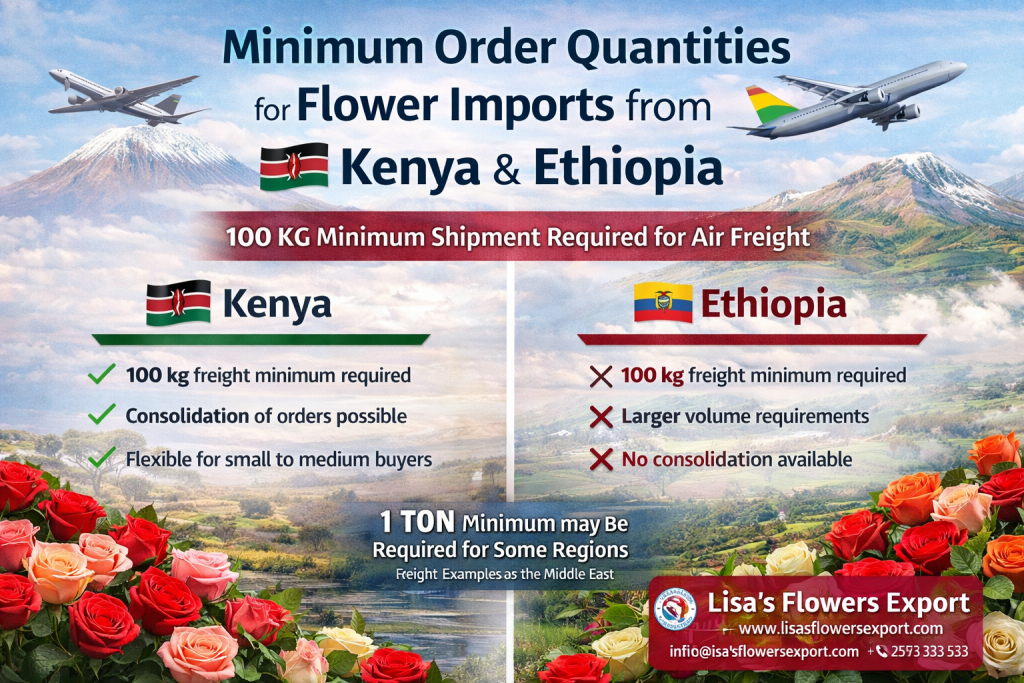
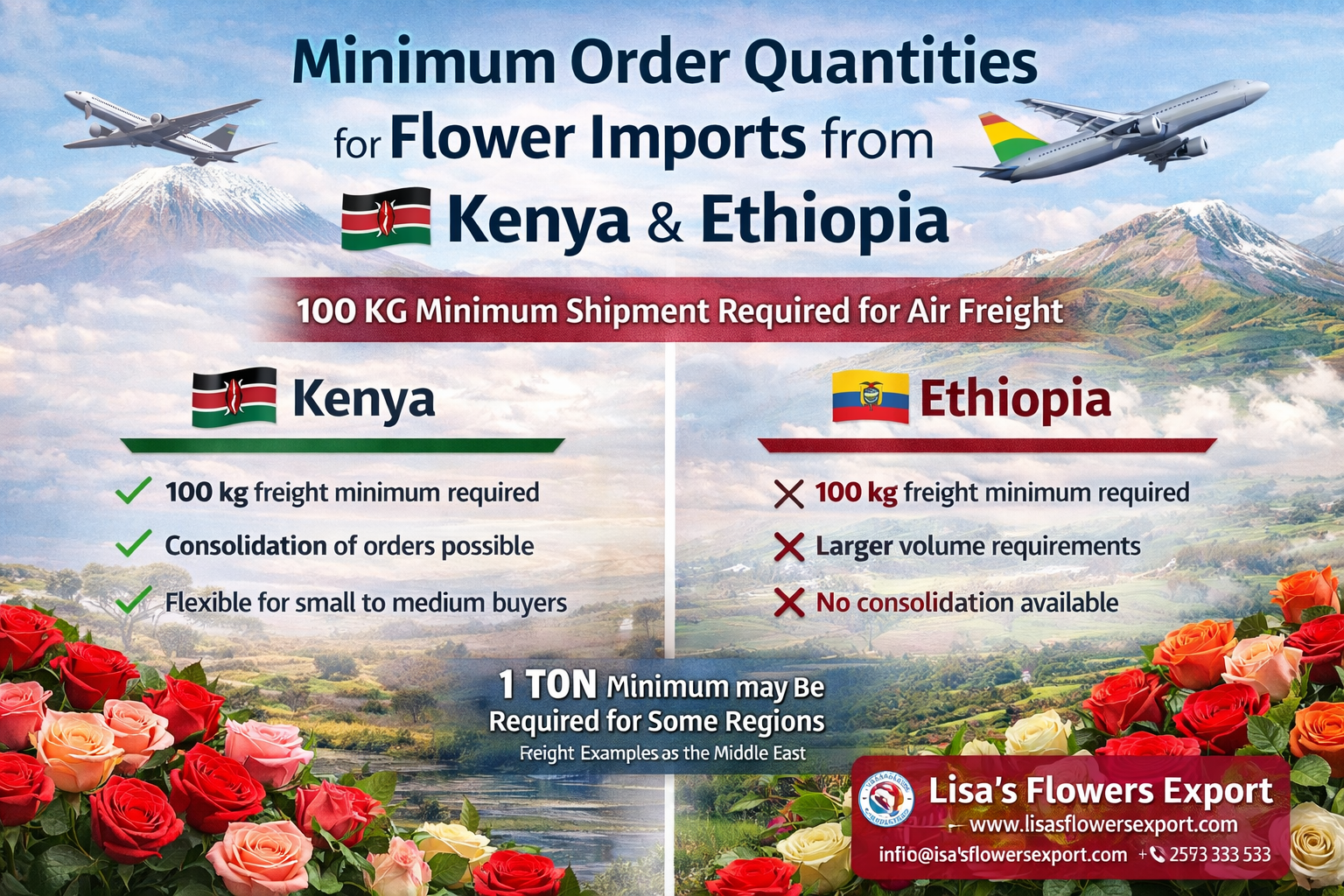
In both Kenya and Ethiopia, air freight is typically calculated with a minimum chargeable weight of around 100 kg.
This means:
- Even if you ship less than 100 kg,
- You will still pay for 100 kg
Example:
- 6 boxes ≈ 70–80 kg
- Freight charged = 100 kg minimum
👉 So you are paying for unused space.
🧠 Key Insight
Because of this:
❗ It does NOT make financial sense to import less than 100 kg
This applies to:
- 🇰🇪 Kenya
- 🇪🇹 Ethiopia
👉 So in practice, your real MOQ is 100 kg, regardless of supplier flexibility.
🇰🇪 Minimum Order Quantities from Kenya
Kenya has a highly developed flower export industry, offering more operational flexibility.
What Kenya allows:
- Smaller box quantities are possible
- Consolidation between farms is available
- Mixed varieties can be arranged
However:
👉 Even if you order fewer boxes,
you will still pay the 100 kg minimum freight
Practical MOQ for Kenya:
- 📦 ~8–12 boxes (depending on packing)
- ✈️ ≈ 100 kg shipment
👉 This is the true efficient starting point
🇪🇹 Minimum Order Quantities from Ethiopia
Ethiopia operates differently.
Key realities:
- Farms typically require larger, consistent volumes
- ❌ No real consolidation system like Kenya
- Exporters expect structured, repeat buyers
Practical MOQ for Ethiopia:
- 📦 Higher box volumes required
- ✈️ Still subject to the 100 kg minimum freight rule
👉 In reality:
- Ethiopia is better suited for larger and more stable buyers
📊 Kenya vs Ethiopia MOQ Comparison
FactorKenyaEthiopiaFreight Minimum100 kg100 kgConsolidation✅ Available❌ Limited / noneFlexibility✅ High⚠️ LowerFarm RequirementsFlexibleHigher volumesIdeal Entry Point~100 kg100 kg+ (structured buying)
💰 Why Ordering Below 100 kg is Inefficient
Many new buyers try to start small—but this often leads to:
- ❌ Higher cost per stem
- ❌ Wasted freight cost
- ❌ Lower margins
- ❌ Inefficient logistics
👉 You are paying for capacity you are not using.
✅ Smart Ordering Strategy
To optimize your imports:
1. 📦 Aim for at least 100 kg per shipment
This ensures:
- Full use of freight cost
- Better cost efficiency
2. 🌹 Mix varieties within your order
Instead of small single-variety orders:
👉 Combine:
- different colors
- different grades
- different varieties
3. 🤝 Work with a sourcing partner
A sourcing partner can:
- structure your order to reach optimal weight
- combine farms (especially in Kenya)
- guide you on best-selling varieties
🌍 Kenya + Ethiopia Strategy
A smart approach many buyers use:
- 🇰🇪 Kenya → flexibility + mixed sourcing
- 🇪🇹 Ethiopia → volume + competitive pricing
👉 But in both cases:
your shipment should be built around the 100 kg freight minimum
⚠️ Important: Freight Conditions Are Changing
It’s important to understand that freight conditions are not fixed.
Airlines and freight forwarders:
- quote differently
- adjust pricing frequently
- change minimum requirements depending on demand and routes
👉 In some cases, especially for destinations like the Middle East,
we have seen minimum freight requirements increase significantly.
Real market example:
- Some airlines or forwarders have required
👉 1,000 kg (1 ton) minimum shipment
🧠 What This Means for Buyers
- MOQ is not static
- It depends on:
- route (Europe, Middle East, etc.)
- season (Valentine’s, peak periods)
- airline capacity
👉 Conditions can change quickly, and flexibility is key
🤝 About Lisa’s Flowers Export
At Lisa’s Flowers Export, we specialize in sourcing flowers from both Kenya and Ethiopia, giving our clients access to a broader and more flexible supply base.
We support buyers by:
- 🌍 Sourcing across multiple farms in Kenya and Ethiopia
- 📦 Structuring orders to meet efficient freight volumes
- 💰 Optimizing pricing based on current market conditions
- ✈️ Managing export logistics and coordination
👉 Our goal is simple:
help you build cost-efficient, reliable shipments tailored to your market
📩 Contact Us
Lisa’s Flowers Export Website: https://www.lisasflowersexport.com
 Email: info@lisasflowersexport.com
 WhatsApp: +254 755 855 955
We respond quickly and are happy to assist with your sourcing and logistics needs.
📩 Final Thoughts
Minimum order quantities in flower exports are driven by air freight economics—and these are evolving.
- The typical baseline MOQ is 100 kg
- Kenya offers more flexibility in reaching that volume
- Ethiopia requires more structured, higher-volume sourcing
- In some markets, MOQ can increase significantly (e.g. 1 ton shipments)
 The key is to stay flexible and informed.
Understanding these dynamics will help you:
- reduce costs
- improve margins
- avoid costly mistakes
Contact us to plan your shipment based on the latest market conditions and your specific needs.
Check out our Flowers